Dialog Teologic XXII/44 (2019)

Dialog Teologic XXII/44 (2019)
68 p., 17×24, ISSN 1453-8075, 15 lei.

DOI: https://doi.org/10.53438/QCJU6536

Cumpără online de la Libraria Sapientia
Vizualizează online Dialog 44.

Ioan Balan
Formare i seminaristi all’uso attento del televisore
Since its inception, the TV has spread rapidly in all homes, becoming an indispensable piece in the family environment around which relationships, habits, lifestyles are built, becoming a simple and inexpensive source of information and use of free time. Recent generations have grown up with TV and become addicted to the small screen, causing psychophysical injuries, uncontrolled behavioral outbursts caused by image culture that influences objective reality, presenting false images as an ambiguous game in which everything appears simple, easy, happy and rich, replacing the truth with the opinion. In a consumer society, advertising is a form of communication that aims to encourage the purchase of products by producing an automation in the listener that immediately accepts the offer of immediate happiness. The modern man can choose to be teleconsumer, teledependent, teleignorant or teleintelligent; but for the fruitful use of the television a slow work is needed based on patience, introspection, interiorization, silence and attentive listening.

Maricel Irinel Mititelu
Il contributo di Rudolf Bultmann (1884-1976) alla teologia del kerigma
From seven billion people on our planet, only two billion are Christians and, from these, a majority are unpracticing Christians. As Pope John Paul II was writing in 1990, “The mission of Christ the Redeemer, which is entrusted to the Church, is still very far from completion” (Redemptoris Missio, 1). Considering all this reality, in the last century we have witnessed a revival of the kerygma in the field of theological research, both theoretical and practical. In the coming articles, we wish to present, in chronological order, the steps through which kerygma became the guiding figure of the renewal of the evangelization in the twentieth century. This article presents the contribution of Rudolf Bultmann to the kerygma.

Ciprian Fechetă
The roots of the question about the origin of man
Since Charles Darwin has came up with the theory of natural selection there has been a never-ending dispute between evolutionism and creationism regarding the origin of man. This tension has led to the searching of the roots, the roots of man and of the speech about him. These roots have to see the man as unity. That’s why the speech concerning the origins of man must be both physical and metaphysical. For this reason, in this article I`ve highlighted the position of man in the cosmos and his nature beyond the seen reality. These aspects consist of the metaphysical intuition of men manifested especially in religion.

Michail Iulian Echert
Laudato si’ – The Merciful Solidarity
Laudato si’, published in 2015, represents Pope Francis’ first social encyclical letter. It has a close connection with two other social documents: Rerun novarum (1891) and Gaudium et spes (1965). Laudato si’ follows the steps of these revolutionary documents, treating the nowadays “new things” and concerning about the right way to interpret the signs of time.
The central motif of interconnection presents in Laudato si’, Pope Francis underlining the profound relationship between the welfare of the natural environment and human well-being. In the current globalised context, the interdependence between states creates the conception of a single world, and for this reason, is necessary a joint plan.
Pope Francis asks for clear solutions and cooperation, especially in ceasing or at least reducing the damages brought upon “Mother Earth”, and, simultaneously, invites the international community to solidarity and collaboration, as an answer to the globalisation of indifference.
Laudato si’ sees the creation as a family. Each creature is considered to be as a sibling for the human being – in other words, it is about of a fraternity of the creation, an ecologic order oriented towards truth, kindness and beauty. Having the same Creator, the humans and nature are on the same road of solidarity, therefore merciful solidarity must be shown to all, as this calling is enrooted in God’s love for every creature.


Dialog Teologic XXII/43 (2019)

Dialog Teologic XXII/43 (2019)
58 p., 17×24, ISSN 1453-8075, 15 lei.

DOI: https://doi.org/10.53438/TLRS2958

Cumpără online de la Libraria Sapientia
Vizualizează online Dialog 43.Louis F. Card. Ladaria S.J.
Obbedienza della fede
Authority and obedience constitute a timeless combination in the life of the Church; in one way or another it touches all the faithful. All are bound to adhere to the magisterium, to respect and to follow the different norms emanated by the legitimate pastors. All this makes sense only if you live in faith. Only in the communion of faith, in the adhesion of mind and heart to divine revelation, does life in the Church make sense. Obedience and faith have many things in common. Without faith we cannot live in obedience and without obedience, in different degrees and modalities, we cannot live the faith.

The process of repentance cannot be a human effort to achieve salvation considering the relationship between the kingdom of God and the Christian and ecclesiastical testimony of faith, hope and love. Rather, it is made possible by the undeserved offer of salvation from God’s reign, which Christians and the faith communities can experience in the world through the lived testimony of faith, hope and love. The promotion of Christian action in the world, which in its individual and social dimensions has to be shaped more intensively than before, can create a climate of action in which the effort and constant renewal of human life are the prerequisites for progress of the metanoia process. Conveying understanding of the world from the gift of faith, offering future perspectives of the world from the power of hope and realizing the unity of the world in the testimony of love are elements that open up opportunities for social metanoia.

From seven billion people on our planet, only two billion are Christians and, from these, a majority are unpracticing Christians. As Pope John Paul II was writing in 1990, “The mission of Christ the Redeemer, which is entrusted to the Church, is still very far from completion” (Redemptoris Missio, 1). Considering all this reality, in the last century we have witnessed a revival of the kerygma in the field of theological research, both theoretical and practical. In the coming articles, we wish to present, in chronological order, the steps through which kerygma became the guiding figure of the renewal of the evangelization in the twentieth century.

The following article is entitled Practical Indications for Spiritual Growth. It takes the Apostolic Exhortation Pastores Dabo Vobis as its starting point, as this document considers the spiritual formation of the priest as “the heart which unites and enlivens both his identity and actions as a priest. We will seek to provide some practical indications suitable to help the seminarian in the process of spiritual growth. Among these indications are included: the indispensability of the Word of God, the importance of the Liturgy, personal prayer, which provides sustenance for service in pastoral charity and devotion to Mary, which accompanies the spiritual life.

Dialog Teologic XXI/42 (2018)

Dialog Teologic XXI/42 (2018)
108 p., 17×24, ISSN 1453-8075, 15 lei.

Cumpară online de la Libraria Sapientia
Vizualizează online Dialog 42.

Cristian Diac
Heilsplan in den lukanischen Begriffen (Lukasevangelium und Apostelgeschichte)
Lukas, der Urheber des dritten Evangeliums und der Apostelgeschichte, ist der Theologe des Gottes Planes und man schreibt ihm am ehesten dieser theologische Leitgedanke zu, obwohl ein planmäßiges Handeln Gottes für das Paulus Denken, insbesondere im Römerbrief nicht fremd erscheint. Es muss klargestellt werden, dass Lukas in seinem Doppelwerk den Gottesplan nicht thematisch behandelt. Er theoretisiert darüber nicht, wie die Stoiker seiner Zeit z.B. Weder im Evangelium noch in der Apg findet man ein Kapitel, wo überhaupt nur vom Heilsplan die Rede ist. Der Plan Gottes wird in seinem Wortschatz, sowie in den großen Themen seiner Theologie entdeckt, wie Heilsgeschichte und Umkehr. Es sind die spezifischen Vokabeln, die darauf hinweisen, dass der Eingriff Gottes in die Geschichte Israels und in den Menschen Jesus von Nazareth einen Leitfaden hat, eine Gesamtheit bildet und zu einem eschatologischen Ziel führt.

Petru Ciobanu
Il clero romano-cattolico di Bessarabia durante il periodo intebellico
The article provides the most important figures of Roman Catholic priests who, during the inter-war period, have been working or were born in Bessarabia. Firstly, there are provided shortly the biographies of the priests who during between two world wars took care of the spiritual well-being of the Bessarabian Catholics, the presentation of their life does not stop at 1940, when Bessarabia was occupied by the Soviets, but goes to the end of each one’s life. Next, there are provided the figures of four priests from the area between Prut and Nistru, who in the interwar period either were born or were ordained as priests. They operating farther within Diocese of Iaşi, even if they do not refer strictly to clergy, we considered it appropriate to provide, at the end, some figures of seminarians who did not reached the time of their ordination as priests, abandoning, from subjective or objective reasons, the path of sacerdotal formation.

Pius Petru Iancu
La formazione dei giovanni presbiteri. Analisi della situazione e prospettive
The beginnings are always difficult and risky. The same situation comes at the beginning of the priestly life. The newly ordained priest enters in the service dedicated entirely to evangelization. In order not to scupper his priestly life, the young priest must be aware that the work of formation does not end with priestly ordination, but continues along the path of life. In this study we want to deepen the connection between initial and ongoing formation, underlining in the same way the resources and risks that run in the lives of young priests. All this to find out valid points that can support the beginnings of the priestly life of those young people who today, with great generosity, offer their lives in the service of God and their brothers.

Iulian Faraoanu
Apertura e universalismo delle porte nella Nuova Gerusalemme di Ap 21
The internal description of the gates of New Jerusalem in Ap 21 focuses the concepts of the opening and universalism. The idea of a continuous opening reveals a change in the function of the gates and sugests a symbolic interpretation. The image of gates always open expresses total acceptance and willingness to receive the incessant flow of the nations that will enter the eschatological Jerusalem. At the same time, their non-closure means the absence of obstacles or barriers for entry into the holy city. This is thw way to universalism. Actually, in the new heavenly Jerusalem enter the nations and their kings, emphasizing the universality of the holy city, in which everyone has the right to enter to enjoy the goods eschatological. The human component, the goods that nations bring, is added to the divine component of the city filled with the splendor and divine glory.

Dialog Teologic XXI/41 (2018)

Dialog Teologic XXI/41 (2018)
66 p., 17×24, ISSN 1453-8075, 15 lei.

Cumpară online de la Libraria Sapientia
Vizualizează online Dialog 41.

Cristian Diac
Rolle Gottes im Freiheitsbegriff von Epiktet
Epiktet sieht im Erreichen der Freiheit die höchste Erfüllung des menschlichen Daseins. Die Freiheit eröffnet sich für ihn als einzige erstrebenswerte Möglichkeit, die Verbindung zwischen ihm, als Teil des Logos, und dem ganzen Logos herzustellen und aufrechtzuerhalten. Aus der Perspektive der Herkunft ist der Logos die Ursache für die menschliche Freiheit. Aus der Perspektive des Zieles ist bedeutet er eine authentische Einheit des Menschen mit sich und dem Kosmos. Der Heilsplan, den Gott nach Lukas in Jesus Christus ausgeführt hat, involviert die Partizipation gegnerischer menschlicher Faktoren, die paradoxerweise dazu führen, dass der Plan sich letztendlich vollzieht.

Ciprian Bejan-Piser
La partecipazione dell’uomo, in particolare della Genitrice di Dio, all’unica mediazione di Cristo nella luce del numero 60 della Costituzione dogmatica Lumen gentium
The number 60 of Lumen gentium summarizes a fireplace carefully prepared by six Popes, (from Pp. Leo XIII up to John XXIII), in which we can identify the desire of the Church to better understand the relationship between man and divine grace and the eventual possibility of man to participate actively. We propose to outline and ask ourselves about the ability or otherwise of man to participate in the unique mediation of Christ as well as the role of the Mother of God, as a perfect image of participated mediation in Christ.

Petru Ciobanu
L’insegnamento cattolico di Bessarabia nel periodo interbellico
This article reviews some aspects of confessional and catechetical education in Bessarabia in the interwar period. The two Polish schools from Chişinău and Bălţi are presented, both of them activating within the parishes “Divine Providence” and “Assumption of Mary” from the two Bessarabia cities, as well as some existing confessional schools in other Catholic communities in the Prut-Nistru area. Besides this confessional education, the topic of catechetical and religious education was covered as well. Based on the archive data, the number of pupils in different years of study, the names of the teachers and the subjects taught are indicated for each educational institution.

Fabian Doboş
L’erezione del Vescovado di Jassy (27 giugno 1884) e gli inizi della nouva diocesi
This article deals with the establishment of the Episcopate of Iasi (June 27, 1884), with highligh on the personality of the first bishop (Nicolae Iosif Camilli) and his pastoral activity. Nicolae Iosif Camilli was an apostolic vicar for Moldavia at the time of his appointment as the first bishop of Iasi. The study also presents the first activity of the first bishop of Iaşi, with focus on his most important work: the establishment of the Diocesan Seminary „St. Joseph” in Iaşi, at the helm of which Bishop Camilli put in charge some Jesuits from Poland. However, this was not to the liking of his Franciscan brothers nor to that of the Superior General of the Franciscan Order. Therefore, after 10 years of pastorate, the first bishop of Iasi resigned in 1894, and the Catholics of Moldova were then led by Săbaoani parish priest Caietan Liverotti as an apostolic administrator until the following year when the Holy See appointed the Swiss Franciscan Dominic Jaquet as Bishop of Iaşi.

Dialog Teologic XX/40 (2017)

Dialog Teologic XX/40 (2017)
62 p., 17×24, ISSN 1453-8075, 15 lei.

Cumpară online de la Libraria Sapientia
Vizualizează online Dialog 40.

Matteo CRIMELLA
«Siate Misericordiosi, come il Padre vostro è Misericordioso» (Lc 6,36). La misericordia di Dio, la misericordia del discepolo

Lo studio contiene alcune riflessioni sul tema della misericordia partendo da Lc 6,36. In nessun passo della Bibbia c’è l’invito ad essere perfetti come Dio è perfetto o misericordiosi come Dio è misericordioso. Non è però inutile ricordare la formula della Legge di santità del Levitico: «Siate santi, perché io, il Signore, vostro Dio, sono santo» (Lv 19,2). Dio chiede agli Israeliti di essere santi, non come egli è santo, ma perché egli è santo. La mancanza di formule simili a quella evangelica, non significa che non vi siano raccomandazioni che esprimono un pensiero simile. Nella vangelo di Luca si tratta d’imitare una maniera d’essere che è prima di tutto quella di Dio. Da Dio il discepolo deve prendere l’esempio, mostrandosi misericordioso.

Lucian FARCAŞ
Entwicklungsstadium der sittlichen Kompetenz
Der Prozess der Entstehung und Entwicklung der ethischen Kompetenz begleitet auf dem Lebensweg die gesamte Existenz des Menschen. Darin sind unterschiedliche Etappen zu sehen und zu klären. Hier sind diverse Niveaus der moralischen Skala zu differenzieren und als solche für das Verständnis der heranwachsenden menschlichen Person zugänglich zu machen. Die Humanwissenschaften bieten zahlreiche Modelle und Methoden für die Analyse der moralischen Ebenen innerhalb der menschlichen Entwicklungen. Besonders moralpsychologische und sozialtheoretische Einsichten im Kontext der Sozialisations-Forschung sind unentbehrliche, hilfreiche Arbeitsinstrumente für die Erhellung der theologisch-ethischen Kompetenz des Menschen.

Prof. Peter SCHALLENBERG
Der Ort der Umweltethik in der Katholischen Soziallehre
Il presente studio intende proporre un punto di vista sul luogo dell’etica dell’ambiente nell’insegnamento cattolico riguardo la dottrina sociale della Chiesa. La prima parte del lavoro è dedicata ad una rassegna dei documenti magisteriali che prendono di mira i problemi dell’etica ambientale, culminando con la lettera enciclica “Laudato si’”. La seconda parte presenta due punti di vista sui problemi dell’ambiente da parte di due teologi tedeschi. L’accento è messo sulla durabilità: le risorse del pianeta dovrebbero essere usate con moderazione e sapienza. Nello stesso tempo si evidenzia il rispetto della creazione secondo i ritmi che Dio ha impresso in essa.

Ciprian BEJAN-PISER
La funzione materna di Maria nell’unica mediazione di Cristo. Il contenuto del numero 60 dell’VIII° capitolo della Costituzione Lumen gentium nel magistero dei Pontefici
L’VIII Capitolo della Lumen gentium, con il suo spirito ecumenico- pastorale, viene definito da Paolo VI un «[…] inno incomparabile di lode in onore di Maria»1 che esprime il fulcro della fede cattolica attraverso un ritorno alla tradizione e alle origini, non in un freddo uno stile normativo, ma dialogico2. Ci proponiamo di tratteggiare, per quanto possibile, alcune linee riguardanti la preparazione del numero 60 della Lg durante i pontificati di alcuni pontefici precedenti e successivi il Concilio Vaticano II. Di seguito cercheremo di individuare la svolta del fattore mariologico nella teologia postconciliare, i diversi inciampamenti riscontrati sul camino teologico-pastorale, il ruolo dello Spirito Santo nella mediazione come anche alcuni interventi ecumenici più pertinenti.

Dialog Teologic XX/39 (2017)

Dialog Teologic XX/39 (2017)
60 p., 17×24, ISSN 1453-8075, 15 lei.

Cumpara online de la Libraria Sapientia
Vizualizeaza online Dialog 39.


Pablo ARGÁRATE
The new bishop of Rome: a revolution?
To many, Christians or not, Francis, the new Bishop of Rome, brings new fresh air into the world. Francis understands the Church as the “People of God” and wants to decentralize its organization. In other words, the Church has to go out, to everybody, especially to the excluded and marginalized, and bring them the joy of Christ’s gospel. In regard to the Catholic Church, his image of a “field hospital” is a very powerful one. Urgent compassion and care is the main task of the Church. But, Francis’ revolution appears to be a re-focusing of the Church on Jesus’ main message of compassion and mercy.

don Matteo CRIMELLA
Educare all’ascolto della parola di Dio. Il Cardinale Carlo Maria Martini maestro appassionato di lectio divina

Lo studio mette in evidenza il ruolo della lectio divina nell’accostamento alla Bibbia. La tradizione cristiana da sempre si è sottoposta all’ascolto della Parola di Dio. Il termine lectio divina viene dalla tradizione patristica e propriamente significa «lettura divina». Si tratta di leggere la Scrittura in spirito di preghiera come Parola di Dio, nell’ambito della nostra vita cristiana, in comunione con la Chiesa e con il suo insegnamento. Non è dunque una lettura privata, non è uno studio esegetico, ma è un vero e proprio momento di preghiera. Nessuno di noi ha la possibilità di incontrare Gesù in carne ed ossa, essendo questa esperienza storica a noi interamente negata, ma indubbiamente tutti possono incontrarlo nella forma della fede e ascoltarlo per mezzo della sua Parola.

Ştefan LUPU
Il contributo di Dumitru Staniloae allo sviluppo della teologia ortodossa rumena
Nell’opera di Dumitru Staniloae esiste una grande varietà di temi e problemi, in cui ha assunto delle posizioni originali, a volte radicali, ma sempre favorevoli al dialogo.
Credo sia possa abbozzare, anche se in modo provvisorio, quella che può essere definita la «visione creatrice» di Dumitru Staniloae, ossia il filo conduttore che dà unità e consistenza alla sua opera. La riflessione teologica del nostro autore si distingue per l’elaborazione di una teologia esistenziale, una teologia cioè che valorizzi pienamente la Rivelazione e l’esperienza ecclesiale del popolo di Dio, poi per una teologia animata dalla spiritualità filocalica e, infine, per una teologia aperta al dialogo vivo con la società contemporanea.

Gabriel Iulian ROBU
„Status naturae lapsae simul et redemptae” (gen 3) in man and woman he created them: a theology of the body by John Paul II
In this article, my intention has been to emphasize the role of the postlapsarian protology (Gen 3) in the anthropology enlightened by the mystery of Christ (status lapsae simul et redemptae). I considered the disastrous consequences of original sin, the perspective of death, the appearance of shame, the change in the meaning of nakedness – a change generated by the triple concupiscence in the human heart, the deformation of the spousal meaning of the human body and the disorder produced in the communio personarum, as they are presented in the catecheses of Man and Woman He Created Them: A Theology of the Body by John Paul II. Finally, from the perspective of the protoevangelium (cf. Gen 3:15), I examined protology and anthropology in the light of Christology, because in Christ it has been historically manifested and eminently revealed who man is and what is his fulfillment.

Dialog Teologic XIX/38 (2016)

Dialog Teologic XIX/38 (2016)
68 p., 17×24, ISSN 1453-8075, 15 lei.

Cumpără online de la Libraria Sapientia
Vizualizează online Dialog 38.

don Matteo CRIMELLA
Le scelte pastorali del cardinale Carlo Maria Martini perché la Chiesa fosse in ascolto della parola di Dio
Lo studio presenta un panorama sulle scelte pastorali del cardinale Carlo Maria Martini. La Parola di Dio ha guidato la predicazione e l’azione pastorale di Martini; egli proponeva cinque parole fondamentali come guida irrinunciabile per la vita della comunità cristiana: il silenzio, la Parola di Dio, l’Eucaristia, la missione e la carità. Dopo quindici anni di servizio episcopale, al termine del Sinodo diocesano 47°, il cardinale sintetizzava il compito della Chiesa per mezzo del verbo “evangelizzare”. La missione della Chiesa è comunicare il Vangelo.

Prof. Dr. Dirk ANSORGE
Der Beitrag der Theologie in einem säkularisierten Europa

L’articolo presente mira a sottolineare il contributo della teologia in un Europa secolarizzata. La scienza teologica conserva il suo ruolo nella società, illuminanando il mistero dell’uomo e della vita. La teologia dialoga con le altre scienze nelle Università per acrescere il sapere umano. Ma, la teologia rivela la sua importanza nelle risposte che offre sul senso della vita. Nello stesso tempo, la teologia risponde alle ardue domane sul futuro dell’Europa e del mondo.

Gabriel Iulian ROBU
The interpretation of the status naturae integrae (gen 1-2) within the adequate anthropology of John Paul II

In this article, my aim has been to emphasize the role played by Gen 1-2 (status naturae integrae) in the theological anthropology of John Paul II. I have attempted to present the relevance of the Elohist and Jahwist traditions about man’s creation for anthropology, emphasising the transition from the original solitude of Adam to the interpersonal communion that reflects the image of God’s Trinity. I also speak of the meaning of original nakedness, of the original unity and of the spousal features of the human body in the sphere of the hermeneutics of gift. I has aimed to show that for Pope John Paul II and Pope Francis, man is a gift and in order to be happy, he/she must become a gift for others. In a hermeneutical context in which everything is a gift of God, including both time and space, man cannot find himself and his fulfillment unless he becomes a gift. The hermeneutics of the gift is one of the many common points addressed by Saint John Paul II and Pope Francis. The abundance with which the two Pontiffs use the term “gift” and the importance they award to this key concept leads us to the conclusion that, according to the recent Magisterium of the Church, the hermeneutics of the gift is itself a gift and a light for the Christian families in the third millennium.

Lucian FARCAŞ
Der im sittlichen sozial bestimmte und bestimmende Mensch

Die Frage nach der moralischen Kompetenz bezieht sich nicht nur auf das Wissen und Wollen hinsichtlich eines sittlichen Aktes, sondern ausdrücklich auch auf das konkrete Können der moralischen Fähigkeit des Menschen. So ist davon auszugehen, dass die sittliche Fähigkeit der menschlichen Personen im Bereich der sozialen Metanoia ihre allgemeine Kompetenz im Sittlichen impliziert. Die moralische Kompetenz wird nicht angeboren, sondern sie wird durch Vermitteln und Lehren erworben, wobei zwei fundamentale Aspekte innerhalb einer moralischen Entwicklung hervorzuheben sind: Der heran-wachsende Mensch wird in seiner Sittlichkeit durch die soziale Mit- und Umwelt bestimmt, gleichzeitig bestimmt er selbst diesen Prozess durch personale Partizipation an der moralischen Entfaltung seiner eigenen Anlagen. In diesem Sinne soll im vorliegenden Artikel die Rede vom im Sittlichen sozial bestimmten und bestimmenden Menschen sein.

Dialog Teologic XIX/37 (2016)

Dialog Teologic XIX/37 (2016)
60 p., 17×24, ISSN 1453-8075, 15 lei.

Cumpara online de la Libraria Sapientia
Vizualizeaza online Dialog 37.

Enrico DAL COVOLO
La teologia: una sfida per le “scienze altre” in un’Europa secolarizzata?

Lo studio parte dalla domanda generica “Che cos’è la teologia (cristiana)?”. Per rispondere a questa domanda è indispensabile una precisazione sulla teologia stessa come scienza e sul proprio metodo. Dopo aver precisato le note essenziali della teologia come scienza e le questioni riguardanti il suo metodo, si lancia un confronto con le altre scienze sullo sfondo della secolarizzazione. Nel panorama delle scienze, la teologia rimane la scienza che può spiegare all’uomo di oggi la sua identità, il mistero del mondo e della vita.

don Matteo CRIMELLA
«i doni e la chiamata di Dio sono irrevocabili» (Rm 11,29) La relazione ebraico-cristiana a partire dalla riflessione di Paolo in Rm 9-11

Il mistero, taciuto ma rivelato in Cristo, è l’evangelizzazione sia per i giudei che per i pagani. Anche se Romani ha spesso prestato il terreno per una duplice concezione dell’elezione al bene e al male, secondo la quale sin da principio alcuni si salvano e altri si perdono, da una comprensione globale e contestuale delle affermazioni paoline emerge un’unica elezione positiva e non negativa, quella realizzata in Cristo mediante la sua morte e la sua risurrezione. Se ci poniamo sul versante della comunità di Roma, come di ogni comunità che riceve questa lettera, Paolo esorta i cristiani di origine giudaica a non vantarsi dei propri privilegi donati da Dio nella storia della salvezza, e quelli di origine pagana a non esaltarsi di fronte all’incredulità di buona parte d’Israele: «Dio infatti ha rinchiuso tutti nella disobbedienza, per essere misericordioso verso tutti!» (Rm 11,32). Dall’universale misericordia di Dio viene la salvezza per tutti.

Iulian Gabriel ROBU
The logic of the “adequate” anthropology in man and woman he created them: a theology of the body by John Paul II and reintroduced in amoris laetitia by pope Francis
This article presents a general introduction to the anthropology of the Pope John Paul II treaty of Man and Woman He Created Them: A Theology of the Body, describing the ecclesial context, the author, its philosophical and cultural formation, the method and content of the treaty, and in the second part the fundamental concepts of the “adequate” anthropology of the Pope as well as the function of the protology for anthropology in general, and for theology of the body in particular. A special place is dedicated both for indicating the implications of the theology of the body and to illustrate its relationship with the Pope’s “adequate anthropology”, and for showing how, like Saint John Paul II, Pope Francis connects the protology with eschatology in a Christological key. Christ is the way to understand both the beginning of mankind and his end. For both popes, Christ is the full man and he is the way that shows man how he/she can truly find personal and mutual fulfillment in married life.

Iosif ENĂŞOAE
Christian parents, children’s first educators according to the documents of the Second Vatican Council
The first and irreplaceable mission of the Christian parents is to be real educators for their children. Having called their children to the banquet of life, Christian parents have the foremost and specific right and, at the same time the, duty to be involved in a total and responsible manner in children’s growth and the whole education process. Aware of the fact that each of their children has the same human dignity as their parents’ dignity, such parents have the duty to educate and train children so that the latter can fully live their vocation, in accordance with human dignity, while promoting personal and common good.
According to the Documents of the Second Vatican Council, the education children have to receive from their parents is complex and shall include all aspects of human life: physical, psychological, religious, moral, social and vocational. To adequately fulfil their mission, parents will make responsible choices in choosing the kindergarten, primary and secondary school and high school for their children; such institutions shall support children and help them in their pedagogical itinerary. From Christian perspective, the most important commitment made by spouses when receiving the sacrament of Matrimony is to transmit faith to their children by Baptism, and to preserve and develop this gift received through catechesis, prayer and personal example. The current education crisis – the result of erroneous ideologies – often encountered also in our families, can be overcome by changing this wrong mentality. This mentality refuses to accept the fact that children are a gift God makes to human family and society, while arguing that children are rather obstacles for the development of their parents or a right owed to such parents. The teaching of the Second Vatican Council is the most appropriate guide for Christian parents called to fulfil their mission of providing their children with a genuine human and Christian education.

Dialog Teologic XVIII/36 (2015)

Dialog Teologic XVIII/36 (2015)
60 p., 17×24, ISSN 1453-8075, 15 lei.

Cumpară online de la Libraria Sapientia
Vizualizează online Dialog 36.

Editoriale
La Chiesa fonda le sue radici nel mistero di Cristo. Dalla persona di Gesù Cristo estrae i principi per il suo essere e il suo agire. Se le cose sono chiare per quel che riguarda la sua esistenza, un problema delicato rimane il suo modo di agire di fronte ai tempi che cambiano continuamente.

Pr. prof. Juan Javier FLORES ARCAS
La Chiesa evangelizza attraverso la liturgia

Questo studio intende presentare alcuni aspetti del ruolo evangelizzatore della liturgia. Lontano dall’essere una somma di riti, la liturgia è un mezzo straordinario per evangelizzare. Questa sua funzione si svolge soprattutto attraverso la celebrazione della Parola e dei sacramenti, tenendo sempre presente che celebrare è in realtà evangelizzare. L’evangelizzazione dovrebbe adeguarsi ai segni dei tempi verso l’ideale di una liturgia della bellezza dentro una Chiesa in cammino verso la perfezione e la patria celeste.

Cettina MILITELLO
La donna segno dei tempi. Narrazione autobiografica e non dell’accesso delle donne allo studio, ricerca, insegnamento della teologia

Il lavoro presente ha l’intento di esporre i significati dell’immagine della donna come segno dei tempi. Già dal titolo si nota che si tratta di una narrazione autobiografica, non necessariamente una apologia a favore di un accesso più largo delle donne allo studio e alla ricerca della teologia. Al centro sta il racconto autobiografico con le sue tappe importanti. Il percorso autobiografico è poi inquadrato nel panorama generale della teologia delle donne in diversi campi di studio e di ricerca. Alla fine è prospettata un’incidenza ecclesiale della teologia “al femminile”.

Iulian FARAOANU
La nuova Gerusalemme nell’Apocalisse: storia e simbolo

The purpose of this paper is to present some aspects of New Jerusalem symbolism in Revelation in relationship with various biblical fragments. In order to describe the image of Jerusalem, it will be a general presentation of the concept „holy city” in the Old and New Testament. The description is followed by short analyses of some fragments from Revelation related to the Jerusalem concept. In the end, comes out reflections about the theological and symbolical figure of the apocalyptical Jerusalem. The holy city is the fulfillment of history and the dream to see God face-to-face.

Fabian DOBOŞ
Paulus VI contra mundum

Il presente articolo vuole trattare e spiegare il modo in cui il Papa Paolo VI è riuscito mettere in pratica l’unico suo scopo: la conversione degli uomini a Dio. Il titolo è dato da un paragone che si può fare tra il Papa Paolo VI e Sant’Atanasio di Alessandria, che ha combattuto dappertutto l’arianesimo, da qui essendo ricavato il sintagma: Atanasius contra mundum.La prima parte dell’articolo tratta della vita e dell’attività di Giovanni Battista Montini prima della sua elezione alla Sede Pontificale; la seconda, divisa in due parti (prima e dopo l’anno 1968) cerca di riassumere l’intero lavoro di un papa che è riuscito a conservare la fede della Chiesa in Cristo.

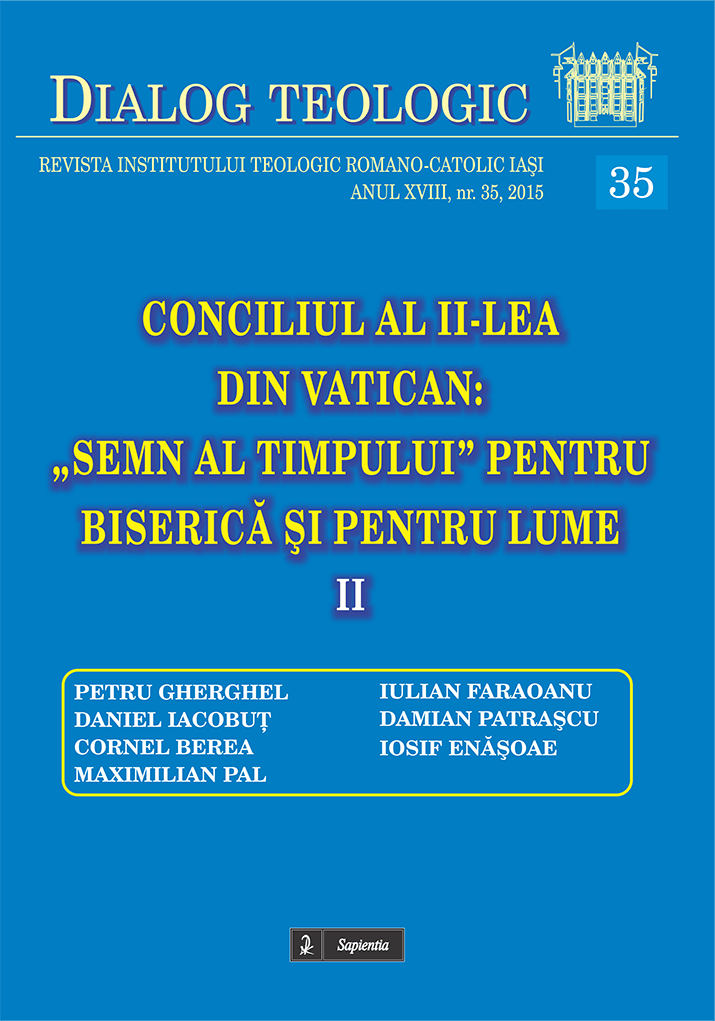
Dialog Teologic XVIII/35 (2015)

Dialog teologic XVIII/35 (2015),
Conciliul al II-lea din Vatican: „semn al timpului” pentru Biserică şi pentru lume (II), 140 p., 17×24, ISSN 1453-8075, 9 lei.

Cumpară online de la Libraria Sapientia
Vizualizează online Dialog 35.


Petru Gherghel
Christus Dominus Decree Concerning the Pastoral Office of Bishops in the Church
I am pleased to participate, although not in person, in this academic meeting organized by the Roman-Catholic Theological Institute of Iasi and the Faculty of Roman-Catholic Theology within the Al. I. Cuza University, and I take this opportunity to express to the rector Fr. Benone Lucaci, PhD, organizer of this symposium, to Fr. Stefan Lupu, PhD, to the fathers associate professors, seminarians, guests and to all participants, a warm welcome accompanied by a wish for heavenly blessing and for distinguished achievements in the mission to continue the analysis of the great Second Vatican Council and to share to all believers, but not only, the richness of the holy teachings developed with a true spirit of faith by the Council Fathers under the coordination of the Holy Father, Saint John XXIII and Blessed Paul VI.

Daniel Iacobuţ
The principle of active participation in Sacrosanctum Concilium
L’articolo si propone di approfondire i fondamenti teologici del principio della partecipazione liturgica nel documento conciliare Sacrosanctum Concilium e di mostrare la sua attualità a 50 anni dall’evento conciliare. La partecipazione attiva alla liturgia è richiesta dalla stessa natura della liturgia, in quanto ogni celebrazione liturgica è azione sacra per eccellenza compiuta da Cristo in unione con il suo corpo mistico, la Chiesa. Siccome la Chiesa è “stirpe eletta, sacerdozio regale, nazione santa, popolo acquistato” (1 Pt 2,9; cfr 2,4-5), tutto il popolo cristiano ha, in forza del battesimo, il diritto e il dovere di partecipare attivamente alla liturgia. Tale partecipazione nu riguarda quindi solo i ministri dell’altare ma l’intera assemblea liturgica, con tutti i suoi membri battezzati. L’oggetto ultimo della partecipazione liturgica è il mistero della fede, al quale si arriva attraverso i riti e le preghiere delle azioni liturgiche. La partecipazione al mistero della fede attraverso i riti e le preghiere deve essere attiva, consapevole, interiore ed esteriore, piena e fruttuosa. Il suo frutto più rilevante è l’accoglienza della salvezza nell’esistenza attraverso una vita di comunione con Dio e i fratelli. Per questo rappresenta ancora a 50 anni dal Concilio lo scopo principale della pastorale liturgica di ogni Chiesa locale.

Cornel Berea
Nostra Aetate. Alla ricerca dei fratelli
L’articolo intende presentare la dichiarazione Nostra Aetate e la sua attualità per la Chiesa di oggi. Partendo dal modo in cui furono percepite, durante il Concilio Vaticano II, le relazioni tra la Chiesa e le religioni non cristiane, l’Autore analizza il contenuto della Dichiarazione, mettendo in evidenza soprattutto la dottrina conciliare sul nostro rapporto con l’ebraismo. Un’attenzione speciale è concessa anche allo sviluppo dottrinale post-conciliare in merito a tale rapporto. L’articolo analizza brevemente sia i documenti importanti del magistero, sia l’atteggiamento da parte ebraica verso i cristiani. L’urgenza di ritrovare nell’ebraismo quelle radici che molte volte abbiamo perso durante la storia fa apprezzare particolarmente gli attuali gesti profetici di Papa Francesco. La ricerca dei fratelli maggiori passa attraverso un’attenzione rinnovata al vocabolario che usiamo, come anche agli errori da evitare nel futuro.

Maximilian Pal
Orientalium Ecclesiarum. Alcuni principi giuridici sulle Chiese orientali cattoliche
Orientalium Ecclesiarum is noteworthy primarily for its exaltation of the equal dignity and relative autonomy of the Eastern patriarchates and its specific prescriptions for increased communion with the separated Orthodox. While this brief document lacks the extensive ecclesiological discussion of Lumen Gentium and Unitatis Redintegratio, its treatment of these two matters gives insight into how the Council interpreted and applied its ecclesiology. The decree’s treatment of the patriarchates makes clear that the particular Churches are essential to the Church’s constitution. They exist by right, not by concession, and on equal terms as regards dignity and jurisdiction, being answerable to none but the supreme authority in the Church. The Pope is considered only in his role as Supreme Pontiff, not as Latin patriarch, to avoid giving any impression that the Latin Church enjoys any jurisdictional superiority over the Eastern Churches. The relative autonomy of the Eastern Churches would be matched by that of future patriarchates, as envisioned by the Council. Thus the Church might adapt to the diversity of the world’s cultures by organizing herself in the ancient system of patriarchates and autonomous eparchies.
In the post-Conciliar period, only the second aim of Orientalium Ecclesiarum was effectively implemented. There is increased communion in sacramental and extra-sacramental practices between Eastern Catholics and Orthodox, mainly to meet the pastoral needs occasioned by geographic dispersion. Yet the expected restoration of patriarchal status never really occurred, as the Eastern patriarchates tend to be governed under a common rule imposed by the supreme authority through the Congregation for the Oriental Churches, which imposes even the norms of ecumenism and other reforms.

Iulian Faraoanu
Gioia per la salvezza di Dio in Sof 3,14-17
The Book of Zephaniah has a multitude references to the Lord’s Day and to the salvation associated to this event. The text of Zeph 3:14-17 offers an example of the right attitude of the people to the salvation of YHWH in that coming day. The prophet often invites the people to the joy and offers motivations for this kind of attitude. This paper intends to present a linguistic, literary and semantic analysis of the most important words used by the author to express his message in Zeph 3:14-17. The analysis is folowed by some theological ideas keeping in mind the hystorical situation of the prophetical oracles. All this confirms the main theme of Zephaniah’s text: the joy for God’s salvation.

Damian Patraşcu
Decreto per il rinnovamento della vita religiosa Perfectae Caritatis
Il presente studio tratta della storia, contenuti e applicazione del decreto conciliare Perfectae caritatis. Come si può ben osservare, anche la storia di questo documento è passato attraverso tante controversie e difficoltà di varie genere prima di arrivare alla sua redazione finale. Nonnostante la chiarezza nella presentazione del rinnovamento alla quale è chiamata la vita consacrata, la sua applicazione non è stata liscia, avendo bisogno di ulteriori pareri da parte dei Romani Pontefici e delle diverse Congregazioni della Curia Romana.

Iosif Enăşoae
La nature humaine degrade, la principale cause de la crise de la famille et de la société
Le mot crise semble être le plus fréquent sur les lèvres des hommes de notre temps. De part le monde entier, on parle beaucoup des crises économique, sociale, familiale et celle des valeurs. Beaucoup veulent découvrir les causes de ces crises perpétuelles afin de proposer des solutions pour y remédier. Une simple étude des causes ne suffit pas pour les identifier. Une recherche plus approfondie est nécessaire, celle de la foi humaine et chrétienne qui dépasse les limites de la raison humaine et qui regarde les réalités de l’existence dans une autre perspective. A travers la puissance de la foi on peut arriver à la découverte de la véritable cause qui a généré la crise actuelle de notre société. La foi, fondée sur la Révélation biblique, nous montre que la véritable cause de la crise de la société humaine est la rébellion des premiers gens contre Dieu, à savoir le péché originel. Il a produit la plus grande catastrophe de la nature humaine, en la blessant grièvement et en la faisant esclave de sa propre impuissance et du Diable. La vraie cause de tous les maux sociaux est le péché originel qui a gravement blessé la nature humaine.